

Most technical job prep has a strange gap in it. You can read the posting, highlight the requirements, and make a heroic list of things to study, but that still does not tell you what to practice first or whether you can handle the messy version of the work. That is why I built Supercharger: a local-first tool that turns job postings, docs, and skill gaps into realistic technical practice.
Supercharger is an open-source technical readiness tool for people who need realistic practice, not just another stack of notes. It started as a way to take a job posting, a resume, or a pile of technical docs and turn them into something you can actually practice, with lessons, quizzes, hands-on labs, and checkpoint validation. Supercharger helps you practice the kind of technical work that shows up in interviews, onboarding, support tickets, and actual jobs.
It is for support engineers, solutions engineers, SREs, technical account managers, DevRel folks, junior engineers, and anyone else who has ever looked at a job posting and thought, “Hey, I know some of these words, but I would prefer not to be cross-examined by them during an interview.”
The Problem With Clean Learning
Clean learning (I’ve used them all: Codecademy, Coursera, Udemy, etc.) has its place. You still need the basics, the meaning of definitions, and what a command does before you start swinging it around like a tiny hammer. But technical confidence usually comes from messier situations, when you need answers fast.
A customer export is missing rows. A timestamp looks right until you remember time zones exist. A SQL query works on the sample data but not so well on the real data. An OAuth flow fails because one setting is wrong, one token is expired, and everyone involved is using the word “redirect” with slightly different levels of panic.
That is the real shape of technical work. It is not always heroic. Sometimes it is patient, boring, and, yes, oddly satisfying. You read the error, check the assumptions, reproduce the issue, and explain what happened in a way another human can use. Then, if all goes well, you resist with all your might the urge to add “as previously stated” to the customer reply. Training should help with that.
What Supercharger Does
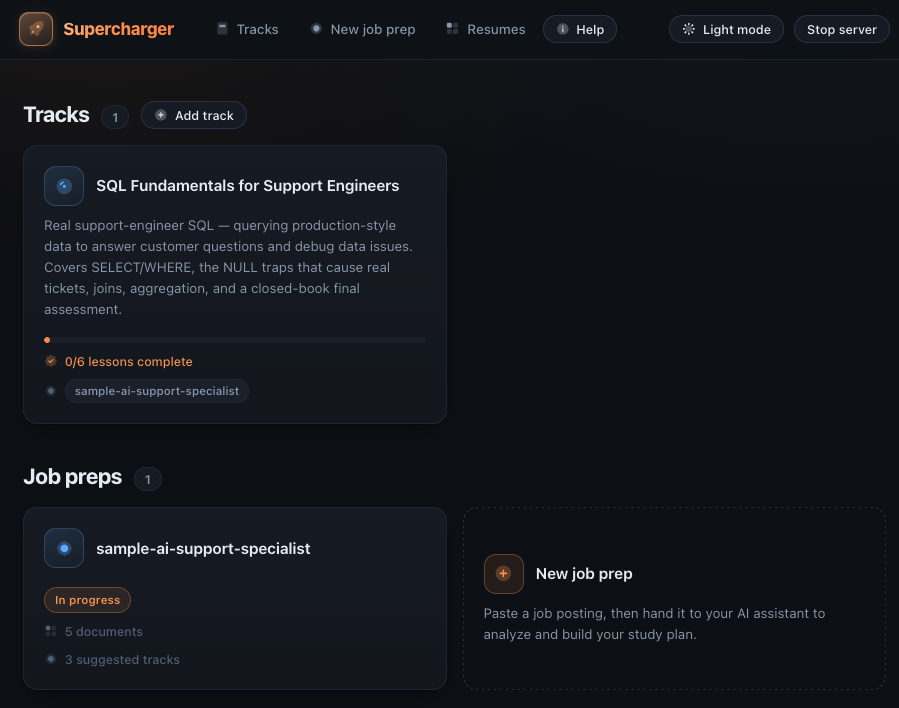
Supercharger keeps the app itself simple. It renders lessons, tracks progress, and opens a real terminal into disposable Docker sandboxes. The curriculum comes from your coding assistant, whether that is Codex, Claude Code, Gemini CLI, or another tool that can read the repo instructions.
You can ask for a track on SQL, Bash, OAuth debugging, SSL troubleshooting, Go, API support, or whatever skill you are trying to build. The assistant reads the project contract and creates a structured track with concept lessons, realistic scenarios, quizzes, hands-on labs, interview prep, and resources.
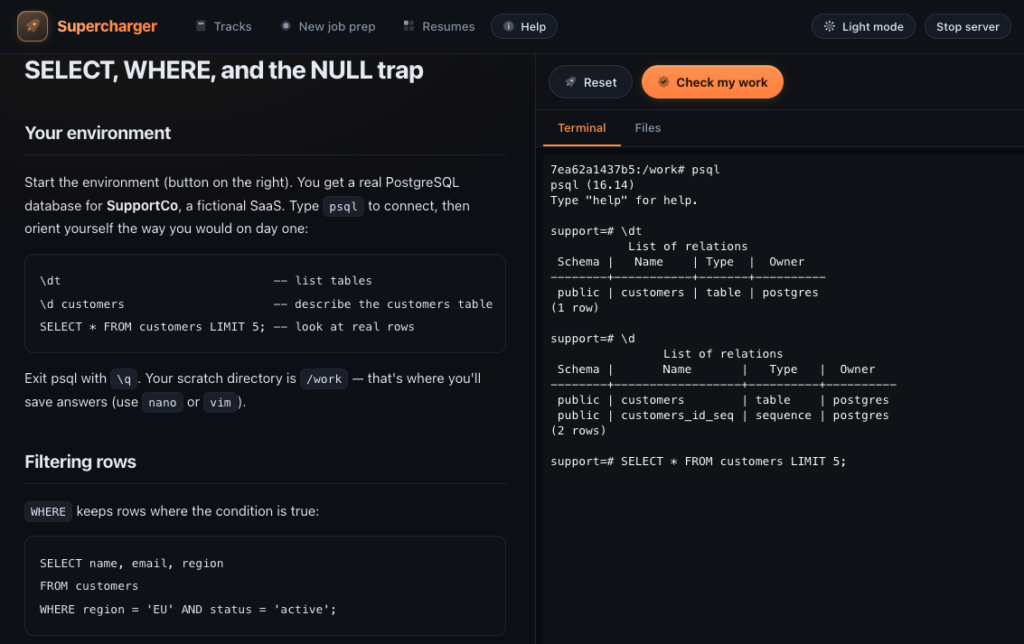
The hands-on lessons are the important part. A lesson might give you a messy database and a support ticket. You investigate the issue in the terminal, save your answer, and click “Check my work.” The check runs inside the sandbox and tells you which checkpoints passed. Not in a vague “great job, buddy” way. More like, “your query still drops customers with NULL plan IDs.” That is the kind of feedback I wanted.
Why I Built It This Way
I did not want Supercharger to become another learning platform that owns the content, the account, the dashboard, the data, and eventually your will to live. Everyone seems to be building another SaaS. I wanted this one to stay local, yours, and useful.
The content is plain markdown and YAML. The app runs locally. There are no accounts, no telemetry, and no API keys required by the app. Your assistant generates the curriculum, and Supercharger gives it a place to live.
That matters because technical readiness is personal. One person might be preparing for a support engineering interview with a heavy SQL component. Another might be onboarding to an internal API. Another might be trying to turn product docs into practice for a team. Those are different needs, and a fixed course catalog will always lag behind them.
Supercharger is built around the idea that the best curriculum is often the one shaped around the actual gap in front of you. Teach me what I need to know, not every command flag ever created.
Job Prep Was the Other Big Reason
A lot of job preparation is strangely abstract. You read the posting and highlight the requirements. You tell yourself you should review networking, databases, Linux, APIs, cloud, logs, troubleshooting, incident response, and maybe the entire history of computing just to be safe.
Then you open twelve tabs and learn nothing with impressive efficiency. Oh, how many times I’ve done this very same thing. I think I still have tabs open from last year that I’ll get around to, I promise.
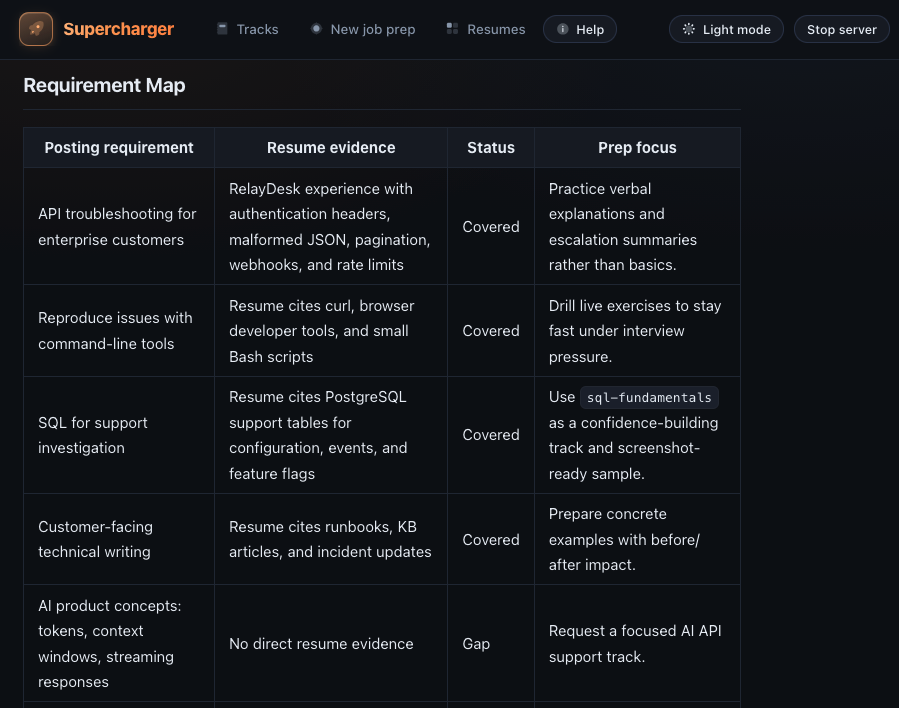
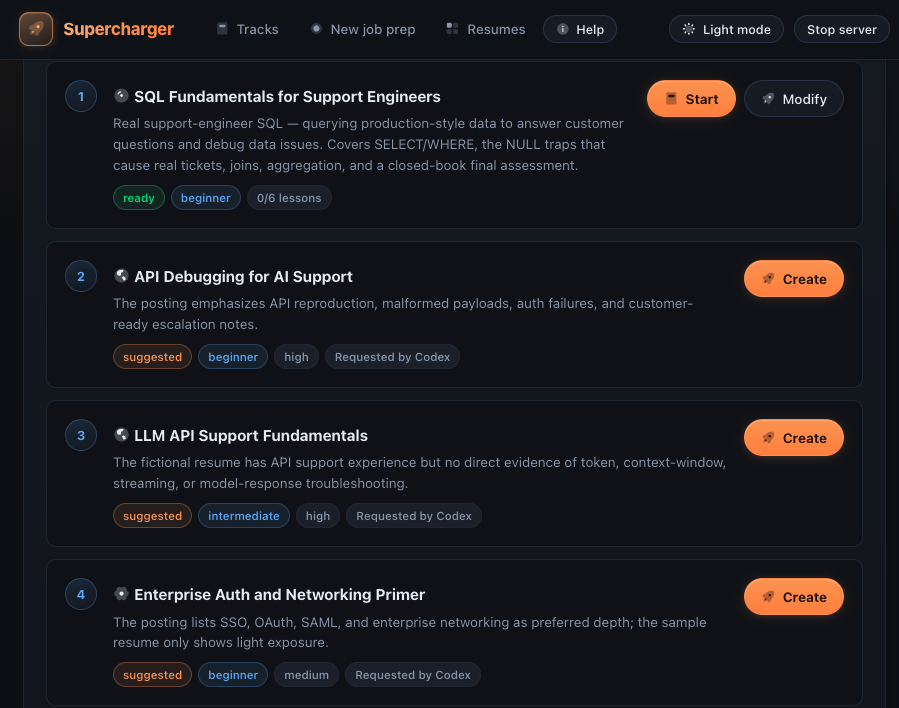
Supercharger can turn a job posting into a study plan. If you include your resume, it can compare the posting against your experience, mark what is covered, what is partial, and what is a real gap, then suggest tracks in the right order. The goal is not to make job prep magical. The goal is to make it less foggy, more laser-focused.
You should know what to skim, what to drill, what to practice out loud, and which resume claims an interviewer is likely to poke with a stick. That last part is important. If your resume says you debugged production API issues, somebody may ask what you actually did. Supercharger should help you prepare for that conversation before you are trapped in a video call making eye contact with your own tiny face.
The Kind of Learning I Want More Of
I want technical learning to feel closer to the work. Less memorizing definitions in isolation, more “here is a broken thing, figure out what happened, fix it, and explain it.” Less pretending that every example has perfect data, more NULLs, time zones, expired certificates, weird customer reports, incomplete logs, and small mistakes that create big confusion.
That is the spirit of Supercharger. It is not trying to replace books, docs, mentors, or real job experience. Those still matter, resource links and book recommendations are included with every plan, if you want to dig further. It is trying to fill the space between “I read about this” and “I can handle this under pressure.” That space is where a lot of people get stuck.
What Comes Next
Right now, Supercharger includes a SQL fundamentals track and a sample job prep. The format is open, and the content is meant to be extended. I want to add more tracks around the practical skills technical practitioners actually need: API troubleshooting, OAuth and identity debugging, Linux command line fluency, logs and observability, SSL and certificate issues, support communication for technical incidents, database debugging, and cloud basics for support and solutions roles.
The long-term idea is not to build a giant course library for passive reading. It is to build a practical readiness system where a person or team can turn the work they actually care about into guided practice. That could be a public track for learning Bash, a job prep for a technical support role, or an onboarding track generated from internal docs that gets you up to speed with the product in record time, no fluff.
Final Thoughts
Supercharger started from a simple frustration: technical training often teaches the really long, perfect environment version, but technical jobs test the messy version. I wanted a tool that could help people practice the messy version in a safe place. A place where breaking things is fine, the terminal is real, and the answer has to work, not just sound confident. Teach you what you need to know, not the nice to know.
And maybe, if it does its job, the next interview, onboarding week, or support ticket feels a little less mysterious.
That is Supercharger: technical practice with fewer flashcards and more actual sparks.
You can try it locally, browse the sample SQL track, or use the repo instructions to generate your own prep.
Leave a Reply